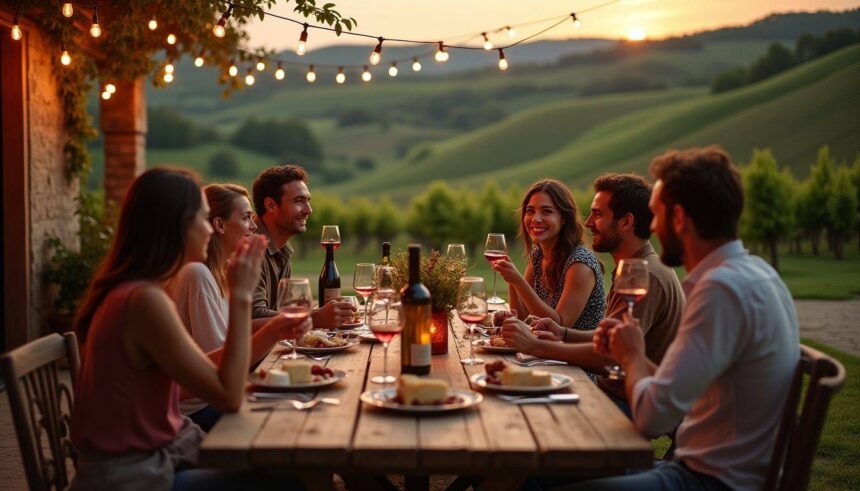

There’s a particular kind of magic that happens around a table. Not the kind that comes from lighting design or careful framing, but the sort that’s born out of easy laughter, long pauses, and the unhurried pour of a wine bottle. In those moments, there’s no script — and no need for one.
The best stories don’t live on paper or in pixels. They happen in real time, in the way someone leans forward to tell you about their grandparents’ vineyard, in the half‑smile that forms as a sip sparks a memory, in the shared silences that say more than words. And in Hungary, that truth is on proud display in every glass.
The Heart of Unscripted Moments
A hungary wine tasting isn’t a polished presentation. It’s an improvisation — between terroir and weather, between the winemaker’s craft and your own senses, between strangers who become friends somewhere between the first and last pour.
Here, a vineyard isn’t a backdrop. It’s a participant. The hills of Tokaj, with their centuries‑old volcanic soil, aren’t just “scenic.” They are active storytellers, lending every drop of wine its own cadence and accent. And in the company of others, those notes begin to harmonize with conversations, glances, and little bursts of joy.
Scene One: The Golden Hour in Tokaj
You arrive just as the sun begins its descent, draping the vines in light the color of ripe apricots. A small group gathers under a wooden pergola. There’s no formal itinerary; the host simply smiles, uncorks a bottle of Tokaji Aszú, and lets the glass find its way to your hand.
Somewhere, a violin starts up — not a stage performance, just a neighbor playing for the sheer pleasure of it. The wine, golden and honey‑laced, picks up the melody. The tart acidity flirts with the sweetness, and together they make a music you can taste. This is exactly what a hungary wine tasting should feel like: unplanned, immersive, and alive in the moment.
Scene Two: Bull’s Blood and the Beat of Boots
In Eger, the energy is different. You’re standing in a courtyard paved with worn stones, holding a glass of Egri Bikavér. This is a wine with a spine — bold red fruit, pepper, and enough earthiness to keep it grounded.
The rhythm starts with the cimbalom, a kind of hammered dulcimer. Then comes the stamping of feet as dancers kick up dust. You taste the wine again, and suddenly the peppery note syncs with the beat, the blackberry richness feels like the bassline. Nobody’s documenting it on their phone. It’s a moment meant to be kept, not posted — the sort of vivid memory that lingers long after your hungary wine tasting tour has ended.
Scene Three: Villány at Midnight
In the wine cellars of Villány, candlelight flickers against old brick walls. Someone pours Cabernet Franc — smooth, with dark cherry, cocoa, and a whisper of herbs. A saxophonist starts to play, weaving sound around the room like a silken scarf.
Your conversation with the person next to you bends and curves in time with the music: a tangent about favorite books, an unexpected confession, a sudden joke that makes the whole table laugh. The wine responds in kind, revealing a different nuance with each sip. It feels alive, like the night itself is improvising.
Scene Four: Furmint in the Open Air
It’s spring in the countryside, and you’ve taken your Furmint outdoors. The nose is citrus and green apple, the palate fresh and bracing. Above you, swallows trace quick arcs in the sky. The air smells faintly of blossoming apple trees.
Every detail becomes part of the pairing: the crispness of the wine mirrors the sharp calls of the birds; the slight minerality in the finish echoes the scent of freshly turned soil. You take a bite of soft cheese, and everything sharpens into focus — a moment simple in form but perfect in composition.
Scene Five: Kadarka and the Firelight
Night has settled in the hills, and the crackle of a wood fire is the only soundtrack. You hold a light‑bodied Kadarka, its spice curling gently against your palate. A platter of cured meats sits between you and your companions, and conversation drifts into slower, softer territory.
The flames shift and dance, casting fleeting shadows. In that warm circle of light, the outside world feels impossibly far away. The wine encourages reflection, but not solitude — it invites you deeper into the shared space, where even silence is communal.
Why This Is the Best “Content”
In marketing, “content” often means something produced for an audience — polished, packaged, and often a little removed from reality. But the best content you’ll ever encounter in Hungary is the kind you’re part of, not the kind you consume.
These are moments that can’t be rehearsed. The winemaker might forget where he left the corkscrew. The music might falter when a breeze flips a page of sheet music. Someone might tell a story that trails off into laughter before it’s finished. And somehow, each of those “imperfections” becomes part of the flavor.
An Invitation, Not a Performance
In Hungary, a wine pour is not just a transaction — it’s an invitation. It says: join me, sit down, taste this, tell me your story. There’s no pressure to craft the perfect sentence or capture the perfect shot. The focus is on being, not broadcasting.
When you leave, you won’t have a printed program or a checklist of scripted takeaways. You’ll carry a memory that feels like a favorite song you can hum but never quite replicate. And every time you open a Hungarian bottle at home, some part of that unscripted magic will find its way back to you — the same way a hungary wine tasting reawakens the senses and reminds you that connection doesn’t need a script.